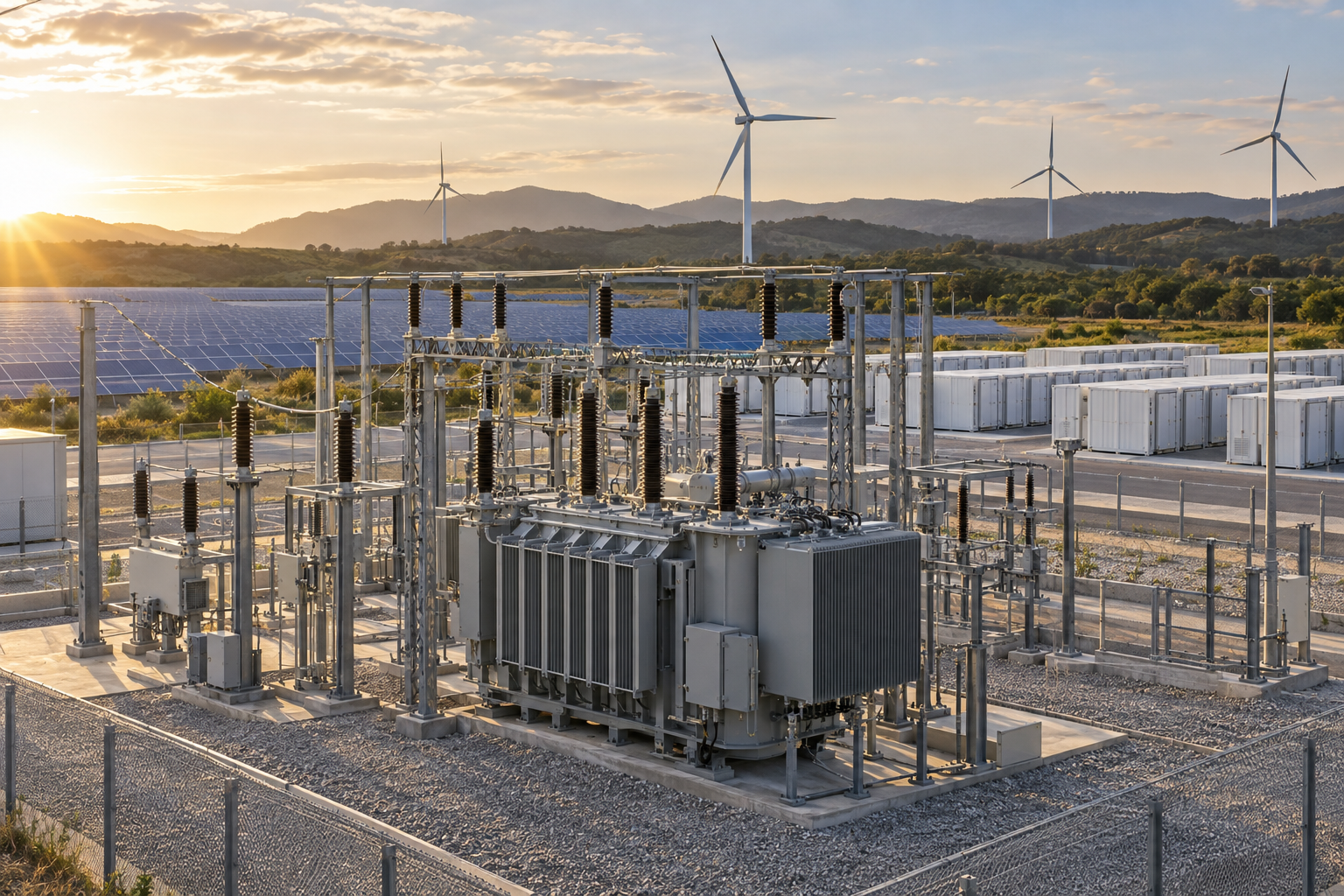
Renewable and storage projects are continuing to reshape grid-connection demand. The U.S. Energy Information Administration reported that developers planned a record 86 GW of new utility-scale generating capacity for 2026, with solar representing 51% of the total, battery storage 28% and wind 14%.
If completed as planned, these additions require a large volume of collector-system equipment, medium-voltage switchgear and generator step-up transformers. Early transformer specification is essential because the electrical interface between the plant and the grid affects losses, protection, voltage control and project schedule.
The Transformer Connects the Plant Design to the Grid Code
Solar, wind and battery projects use power-electronic converters, but their transformers still have to satisfy conventional requirements for voltage ratio, insulation level, temperature rise, impedance and short-circuit withstand. They may also face project-specific requirements for harmonics, reactive-power operation, repeated cycling and bidirectional power flow.
The grid operator’s connection study can change the required impedance, tapping range, grounding arrangement or protection philosophy. Ordering before these parameters are stable can create redesign, approval delays or equipment that limits the plant’s operating envelope.
Information Suppliers Need Before Quotation
Plant configuration: provide the single-line diagram, block size, inverter quantity and collector-system voltage.
Operating envelope: state maximum active and reactive power, power direction, overloads and expected daily or seasonal profile.
Power quality: include harmonic studies or inverter spectra and define any limits at the point of connection.
Site conditions: confirm ambient temperature, altitude, pollution level, seismic duty, corrosion class and transport restrictions.
Testing and documentation: list routine, type and special tests, drawing approvals, digital files and witness requirements.
Solar and Storage Create New Operating Combinations
Many large projects combine solar generation and battery storage. The battery may absorb solar production, charge from the grid or discharge during high-value periods. These combinations can change the net power and reactive-power profile seen by the main transformer throughout the day.
Transformer capacity should therefore be based on the agreed simultaneous operating cases, not only the sum of installed megawatts. Thermal modelling, losses and tap selection should be checked against the scenarios the plant control system will actually permit.
Protect the Schedule With Early Technical Alignment
Renewable projects often develop faster than major grid reinforcements. Developers can reduce equipment risk by freezing the electrical data sheet, interface responsibilities and approval schedule early. A technically complete enquiry also makes supplier quotations easier to compare because exceptions, losses and accessories are visible before an order is placed.
Utility-scale battery storage is expanding rapidly. The U.S. Energy Information Administration reported in August 2026 that operational battery storage capacity reached nearly 52 GW in the first half of the year after averaging 70% annual growth o...
Grid connection queues are becoming a central issue for power-system developers. The International Energy Agency’s Electricity 2026 report says more than 2,500 GW of renewable generation, storage and large-load projects are waiting in connection q...
تظل المدد الزمنية لتوريد المحولات وسلاسل التوريد الخاصة بالشبكات الكهربائية من العوامل المهمة في عام 2026. يرجى مراجعة المواصفات الكهربائية وشروط التركيب والكفاءة والشهادات والوثائق التي يجب على المشترين التأكد منها قبل تقديم الطلبات.
مع التطور السريع لتكنولوجيا الطاقة الكهروضوئية، حظيت الخلايا الشمسية البيروفسكايتية (PSCs)، التي تتميز بكفاءة عالية وتكلفة منخفضة، باهتمام كبير، حيث تتمتع بإمكانية استبدال الخلايا التقليدية المصنوعة من السيليكون البلوري. وعلى وجه الخصوص، فإن الخلايا المرنة...
 الفئات المميزة











إرسال استفسار عن المنتج
سنتصل بك في غضون 24 ساعة